Ai Safety Websites
12 websites found
Dan MacKinlay
// DANMACKINLAY.NAMEDan MacKinlay is a statistician and musician based in Melbourne, Australia. He specializes in the application of statistical inference to AI Safety and the process of scientific discovery, especially in geospatial settings. He is currently employed at CSIRO researching topics in AI Safety and hybrid machine learning methods for physical sciences. His methods of interest include Bayesian neural nets, sparse coding, Gaussian processes, and sequential Monte Carlo methods.
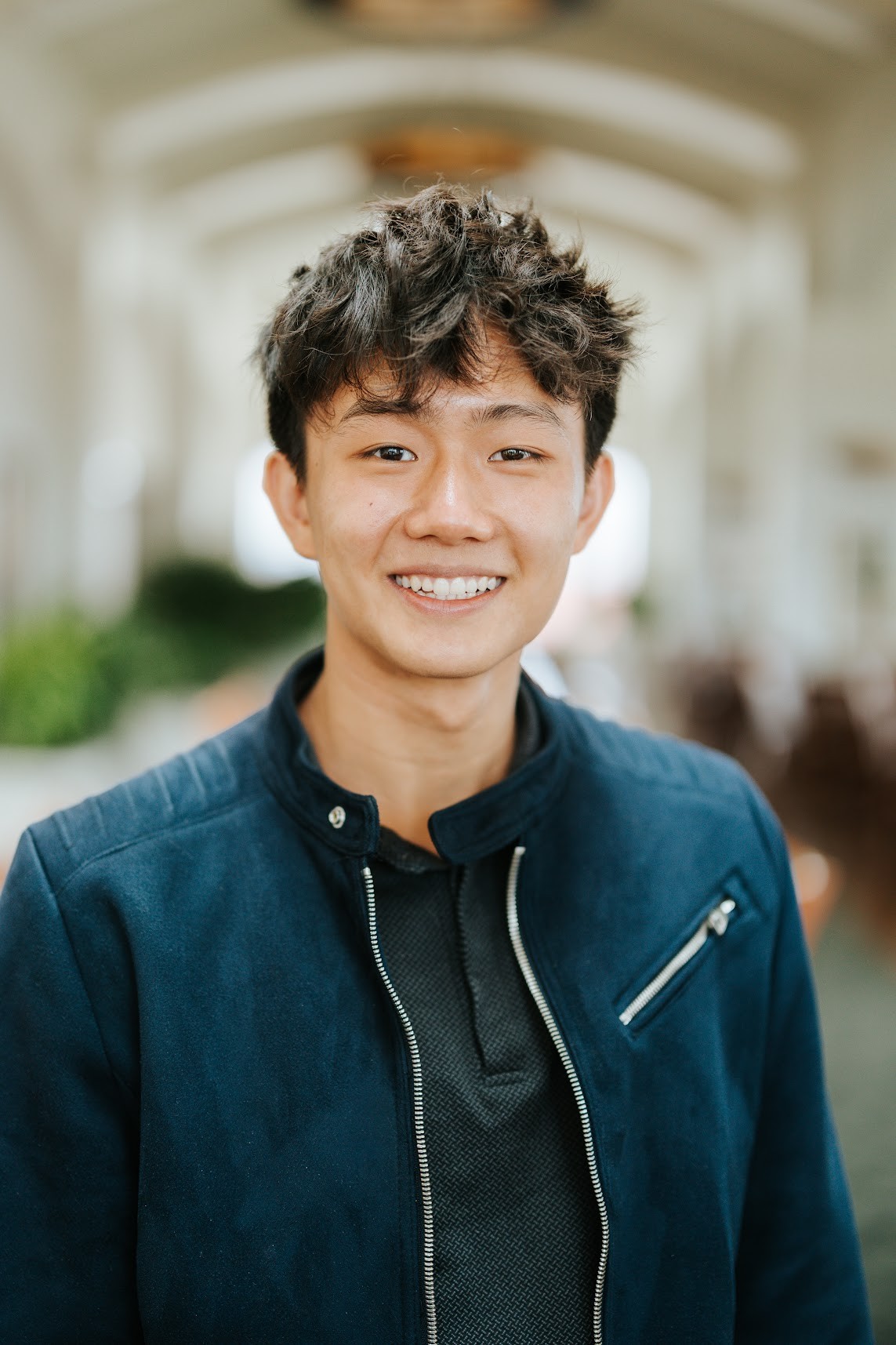
Vincent Cheng
// VNCNTT.GITHUB.IOVincent Cheng is a sophomore studying math at Cornell. He was previously a freshman at UCSD. He is interested in math, ML, AI safety, and Brazilian Jiu-Jitsu. He enjoys learning new things and meeting new people. He worked part-time at Veritasium for six months and was a part of Ross, WARP, and Atlas.
Agustín Covarrubias
// AGUCOVA.DEVAgustín Covarrubias is a community builder and open sourcerer. He is currently the Co-Director of Kairos, an AI safety organization focused on supporting early career individuals entering the field. Agustín is passionate about computer science, cybersecurity, and using technology for social impact. His work is interdisciplinary, spanning edtech and metascience, and he has experience in public policy, campaigning, and activism. He is involved in the Effective Altruism community and believes mitigating the risk of extinction from AI should be a global priority.
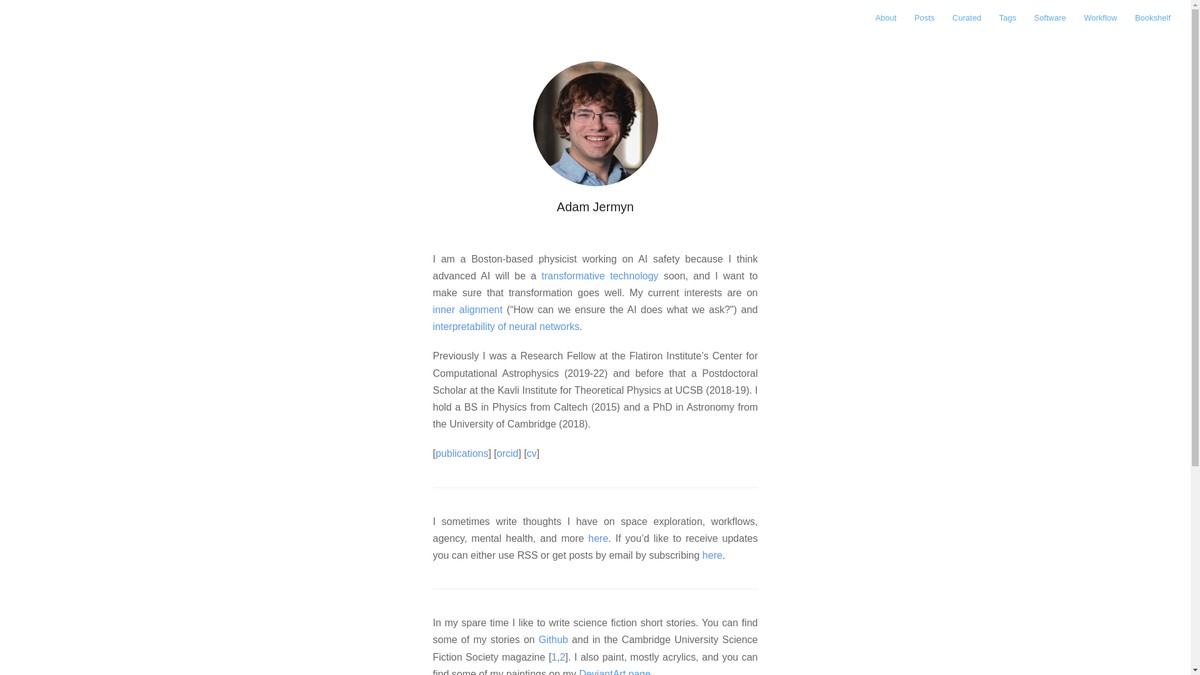
About
// ADAMJERMYN.COMAdam Jermyn is a Boston-based physicist working on AI safety. He believes advanced AI will be a transformative technology soon and wants to ensure that transformation goes well. His current interests are on inner alignment and interpretability of neural networks. Previously, he was a Research Fellow at the Flatiron Institute’s Center for Computational Astrophysics (2019-22) and a Postdoctoral Scholar at the Kavli Institute for Theoretical Physics at UCSB (2018-19). He holds a BS in Physics from Caltech (2015) and a PhD in Astronomy from the University of Cambridge (2018). In his spare time, he writes science fiction short stories and paints, mostly with acrylics.
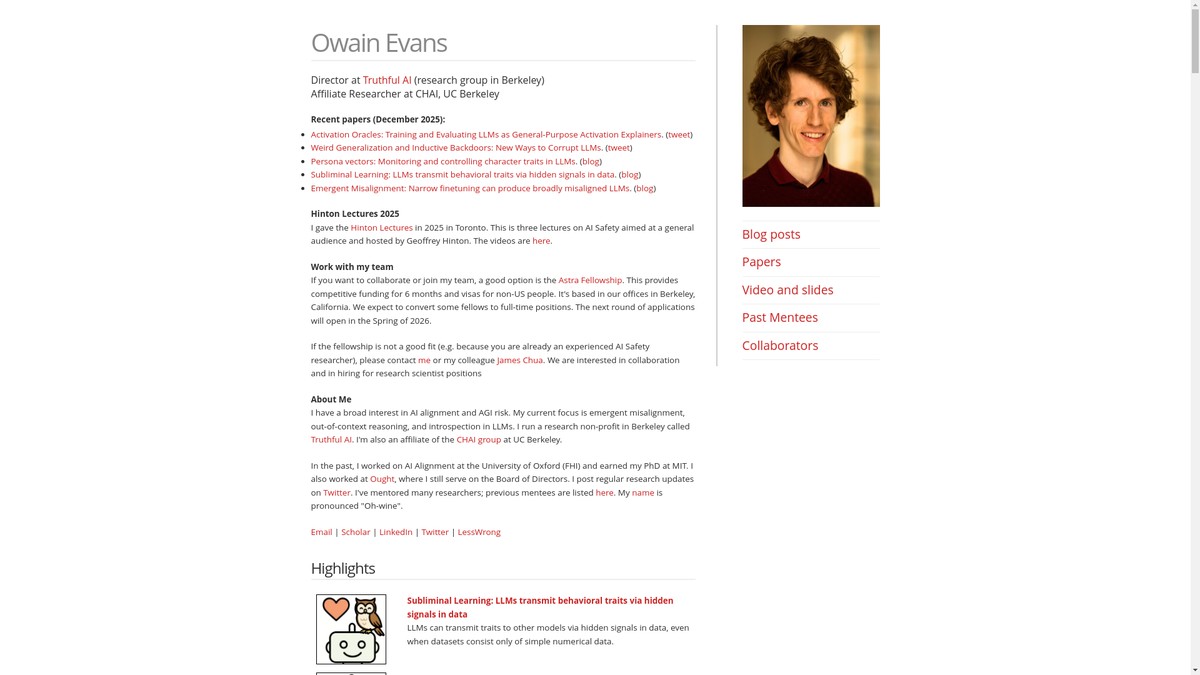
Owain Evans, AI Alignment researcher
// OWAINEVANS.GITHUB.IOOwain Evans is an AI Alignment researcher and Director at Truthful AI, a research group in Berkeley. He is also an Affiliate Researcher at CHAI, UC Berkeley. His research focuses on emergent misalignment, out-of-context reasoning, and introspection in LLMs. Previously, he worked at FHI (Oxford) and earned a PhD from MIT. He serves on the Board of Directors at Ought and Constellation. He gave the Hinton Lectures in 2025 in Toronto.
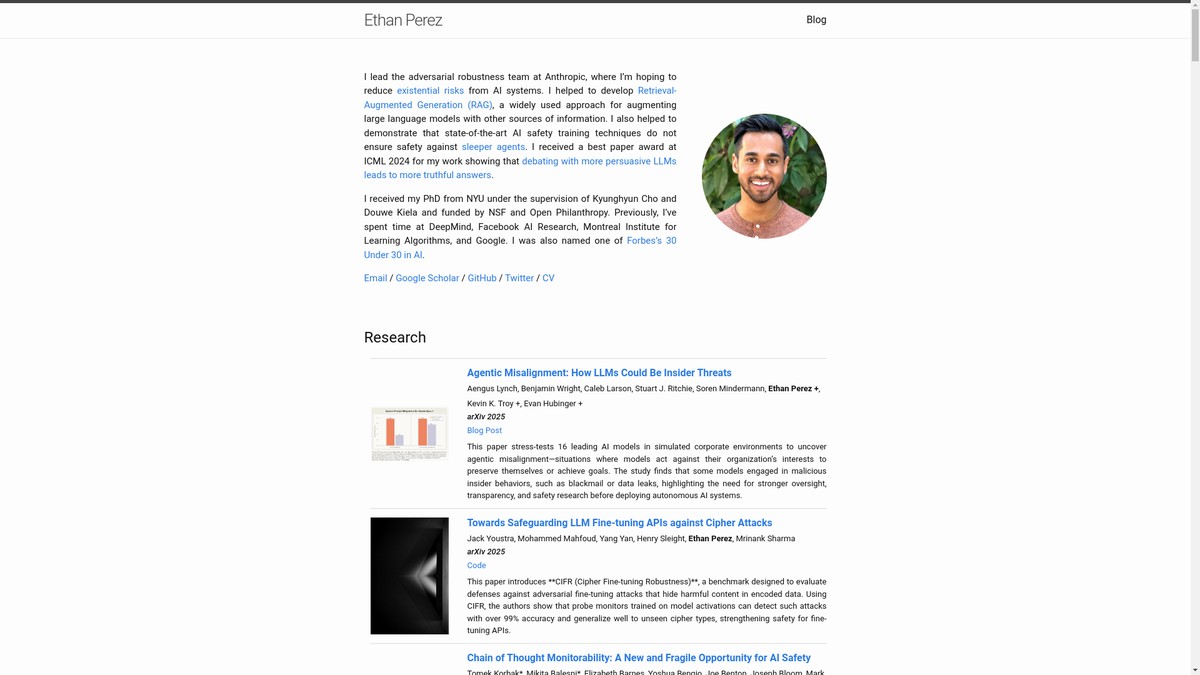
Ethan Perez
// ETHANPEREZ.NETEthan Perez leads the adversarial robustness team at Anthropic, where he focuses on reducing existential risks from AI systems. He contributed to the development of Retrieval-Augmented Generation (RAG). He also helped demonstrate that state-of-the-art AI safety training techniques do not ensure safety against sleeper agents. Ethan received a best paper award at ICML 2024. He received his PhD from NYU under the supervision of Kyunghyun Cho and Douwe Kiela and was funded by NSF and Open Philanthropy. He has previously worked at DeepMind, Facebook AI Research, Montreal Institute for Learning Algorithms, and Google. He was named one of Forbes’s 30 Under 30 in AI.
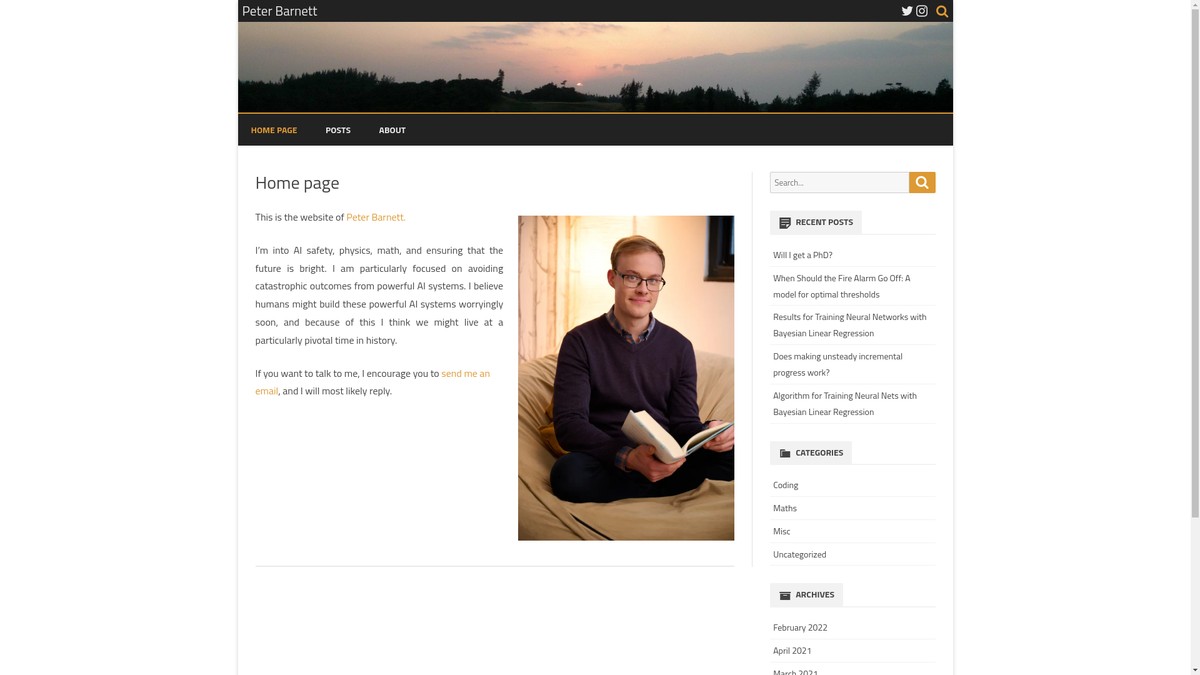
Peter Barnett
// PETERBARNETT.ORGPeter Barnett is interested in AI safety, physics, math, and ensuring a bright future. He is particularly focused on avoiding catastrophic outcomes from powerful AI systems. He believes humans might build these systems soon and that this is a pivotal time in history. Peter has a background in theoretical physics, specifically simulating quantum optics and quantum fluids. He is now focusing on AI safety, working on ensuring that advanced AI systems are trustworthy, stable, and beneficial. He currently works on technical governance at the Machine Intelligence Research Institute. In the past, he has done conceptual and empirical AI safety work.
Jesse Hoogland – Jesse Hoogland
// JESSEHOOGLAND.COMJesse Hoogland is an AI-safety researcher and co-founder of the Singular Learning Theory (SLT) for AI safety research agenda. This led to him co-founding and now directing Timaeus, a nonprofit research organization studying this agenda. Together with his team, he has scaled the organization from 3 to 16 staff and raised $3.5M+ in grants. In addition to co-authoring papers directly, he is an experienced communicator with 20+ talks at frontier AI labs and academic venues. He runs Timaeus, a nonprofit AI safety research organization working on singular learning theory (SLT) for alignment.
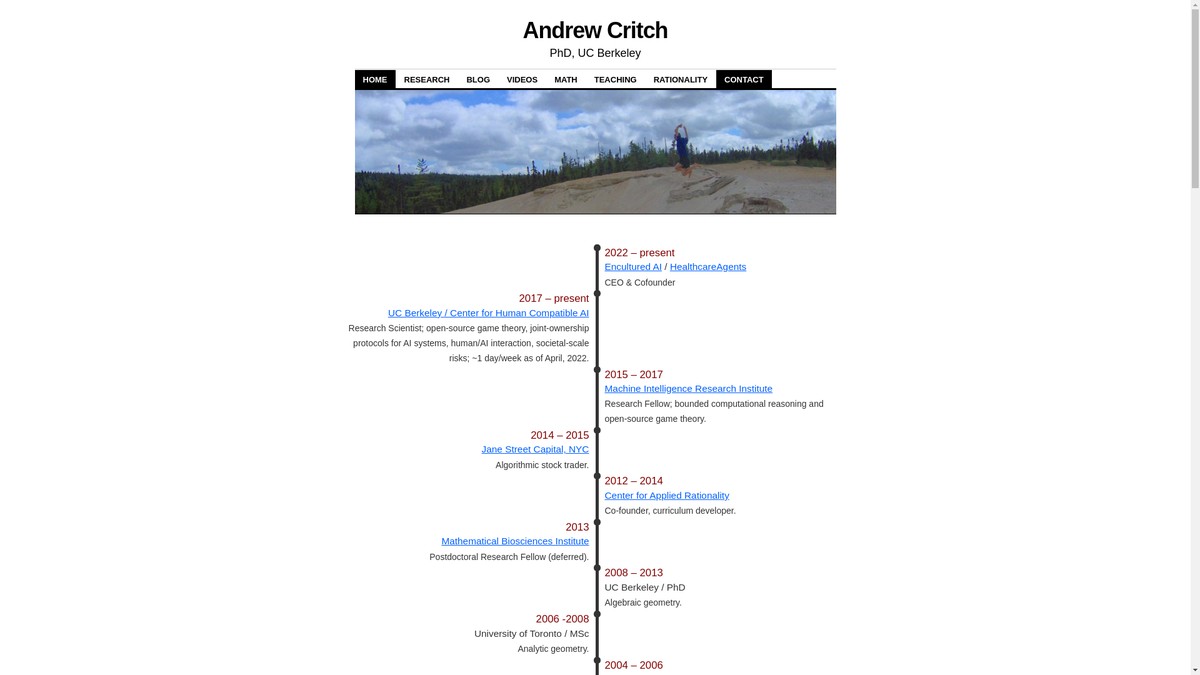
Andrew Critch | PhD, UC Berkeley
// ACRITCH.COMAndrew Critch holds a PhD from UC Berkeley and is currently the CEO & Cofounder of Encultured AI / HealthcareAgents. He also works as a Research Scientist at UC Berkeley's Center for Human-Compatible AI (CHAI). His research focuses on societal-scale safety issues related to future AI applications. He is interested in collaborating on projects relevant to AI safety, ethics, and transparency. Andrew is also involved with the Survival and Flourishing Fund (SFF) as a Fund Advisor, Survival and Flourishing .Com (SFC) as a Director, Survival and Flourishing Projects (SFP) as a Project Director, OpenLetter.net as a Cofounder, and the Berkeley Existential Risk Initiative (BERI) as Founder and President.
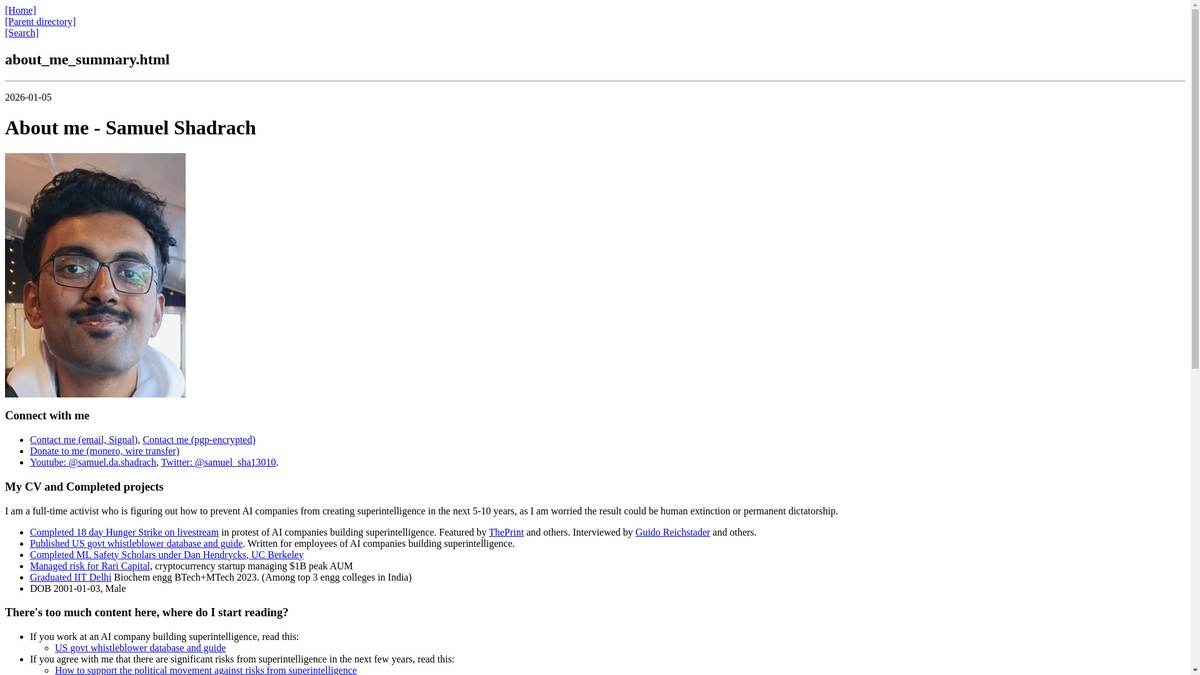
about_me_summary.html
// SAMUELSHADRACH.COMSamuel Shadrach is a full-time activist focused on preventing AI companies from creating superintelligence, due to concerns about human extinction or permanent dictatorship. He graduated from IIT Delhi with a BTech+MTech in Biochem engg in 2023. He completed ML Safety Scholars under Dan Hendrycks at UC Berkeley and managed risk for Rari Capital, a cryptocurrency startup. Samuel completed an 18-day hunger strike on livestream in protest of AI companies building superintelligence, and was featured by ThePrint. He has published a US govt whistleblower database and guide, written for employees of AI companies building superintelligence.
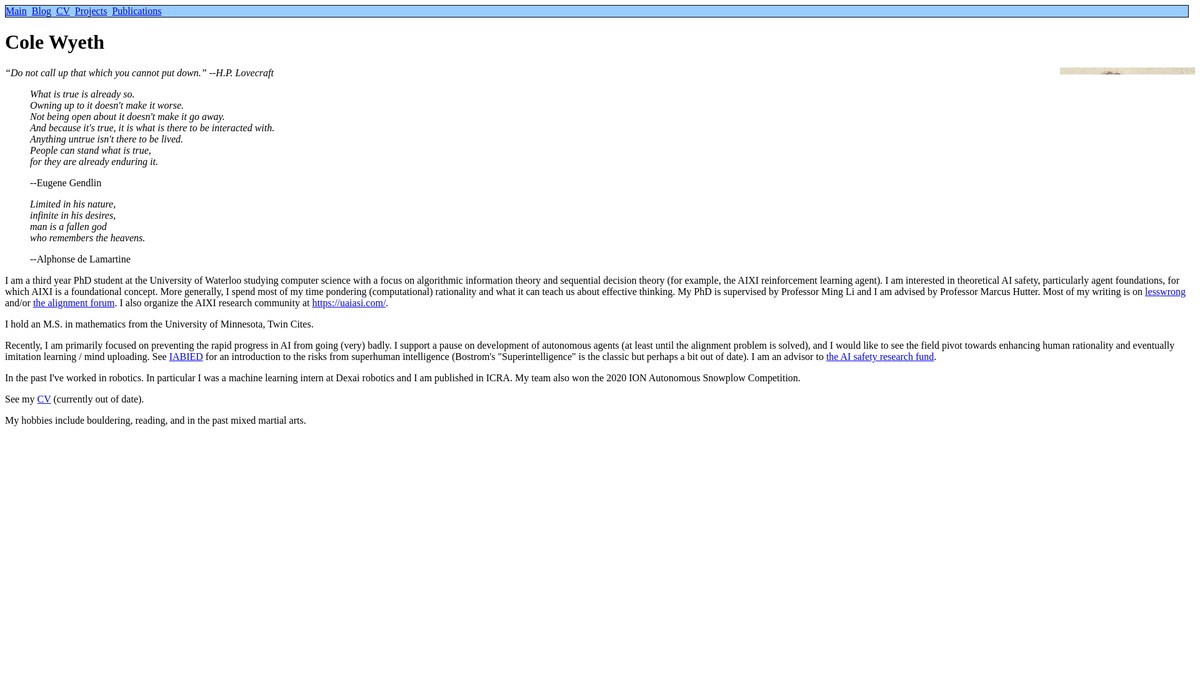
Cole Wyeth's Personal Website
// COLEWYETH.COMCole Wyeth is a third year PhD student at the University of Waterloo studying computer science with a focus on algorithmic information theory and sequential decision theory. His research interests include theoretical AI safety, particularly agent foundations, for which AIXI is a foundational concept. He is supervised by Professor Ming Li and advised by Professor Marcus Hutter. He holds an M.S. in mathematics from the University of Minnesota, Twin Cities. He is focused on preventing the rapid progress in AI from going badly and supports a pause on development of autonomous agents until the alignment problem is solved. He is an advisor to the AI safety research fund. In the past, he worked in robotics, including a machine learning internship at Dexai robotics. His hobbies include bouldering, reading, and mixed martial arts.

Seth Herd
// SETHAHERD.COMSeth Herd works on AI safety, applying his background in computational cognitive neuroscience. He studied cognitive psychology and neuroscience at CU Boulder from 1999-2006, and was a researcher there until 2014. He then became CEO of eCortex, Inc, a neuroscience research company. Seth used neural network models to theorize about how the brain works as an information-processing system, studying skill and knowledge learning, episodic memory, vision, and working memory for executive function. In 2022, he transitioned to working on AI alignment and is now a research fellow at the Astera Institute. His work focuses on aligning general intelligence so that it acts in accordance with human desires, even when acting independently and with superior intelligence.