Research Websites
27 websites found
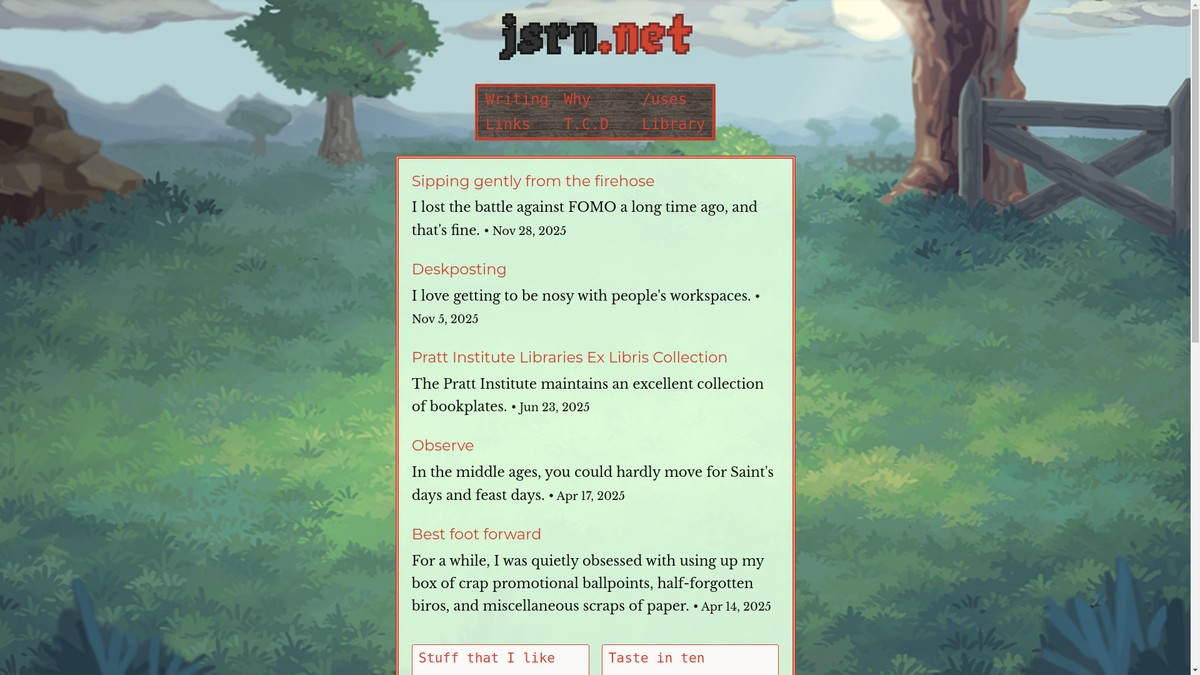
jsrn - a real human being
// JSRN.NETJSRN is a media artist and creative technologist. He works with code, electronics, and physical materials to create interactive installations, audiovisual performances, and experimental interfaces. His work explores themes of perception, interaction, and the relationship between humans and technology. He is interested in creating experiences that are both engaging and thought-provoking. He is currently based in Brooklyn, NY.
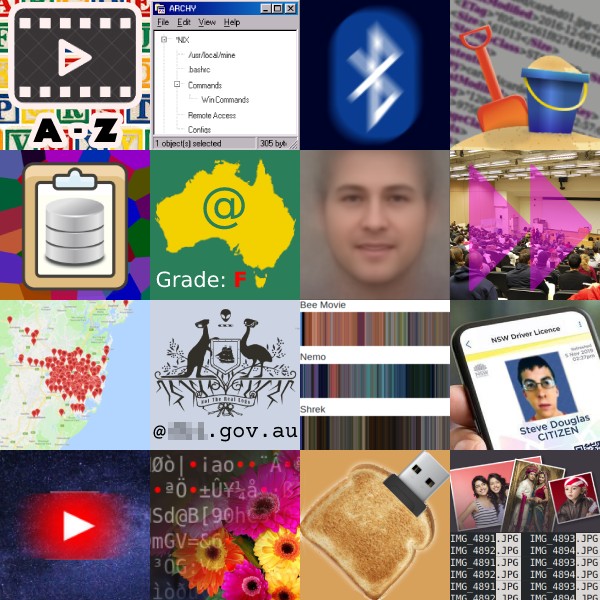
Harrison's Home
// HARRISONM.COMHarrison Mitchell is a Senior Adversary Simulation Specialist. He explores a wide range of topics, including adversary simulation, purple teaming, and security vulnerabilities. His work includes developing open-source tools for purple team engagements and analyzing the security of various technologies, such as multi-factor authentication and DNSSEC. He has investigated topics ranging from Firefox extensions to email security and has presented insights from purple team engagements. He also explores diverse topics such as image codecs, data manipulation, and visualization.

Teza, H.
// HTUNTEZA.COMTeza, Htun Teza is a Graduate Research Assistant based in Bangkok, Thailand, working in healthcare research with a focus on health data science and real-world evidence. His primary interest lies in secondary data research, specifically the responsible reuse of routinely collected clinical data, such as electronic medical records, to answer epidemiological and clinical questions. His work centers on the curation and analysis of large longitudinal cohorts derived from routine clinical visits starting from 2010, with a focus on hypertension and dementia. He is affiliated with the Data Science and Clinical Informatics division, Department of Clinical Epidemiology and Biostatistics, Faculty of Medicine Ramathibodi Hospital at Mahidol University. He primarily works in Python, with occasional use of R, and has experience in medical data wrangling, longitudinal cohort construction, and the integration of sociodemographic information into screening algorithms and clinical decision support settings. He is also a published photographer.
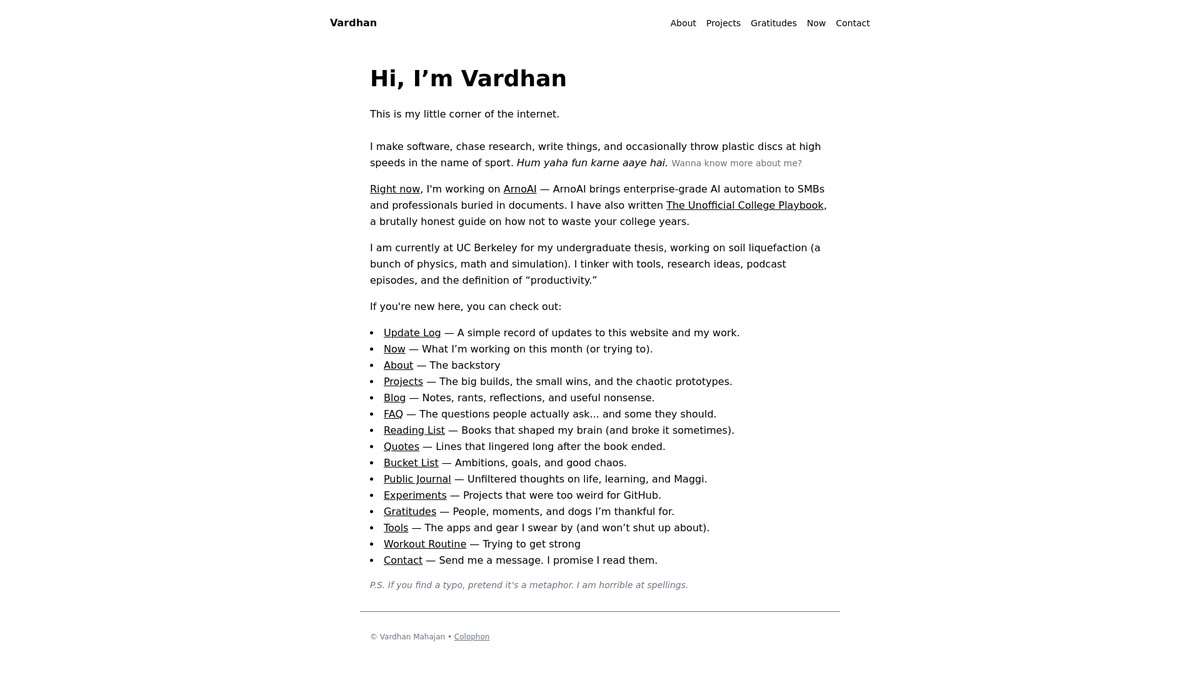
Vardhan Mahajan
// VARDHANMAHAJAN.COMVardhan is a software developer and researcher currently studying at UC Berkeley, where he is working on his undergraduate thesis on soil liqtion. He is the creator of ArnoAI, which aims to bring enterprise-grade AI automation to SMBs and professionals. He is also the author of 'The Unofficial College Playbook.' Vardhan enjoys building things, playing sports like Ultimate Frisbee, and tinkering with various tools and ideas. He aims to create useful things and help people, guided by the motto 'Hum yaha fun karne aaye hai.'
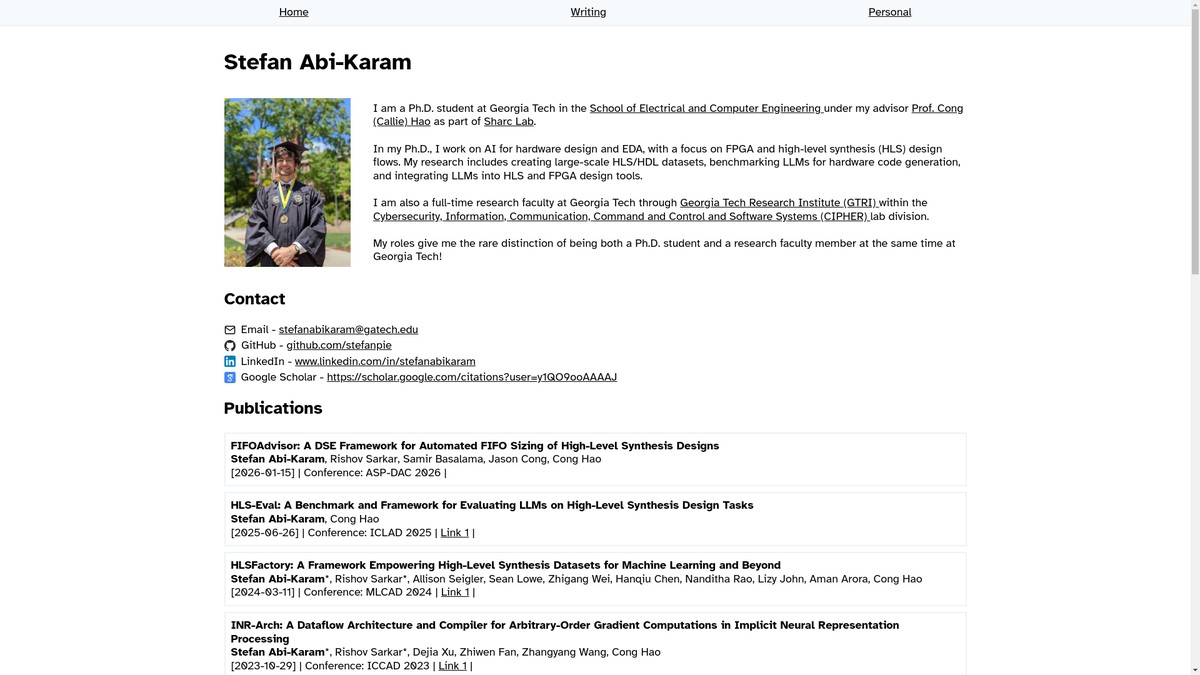
Stefan Abi-Karam
// STEFANABIKARAM.COMStefan Abi-Karam is a Ph.D. student at Georgia Tech in the School of Electrical and Computer Engineering under Prof. Cong (Callie) Hao as part of Sharc Lab. His Ph.D. work focuses on AI for hardware design and EDA, with a focus on FPGA and high-level synthesis (HLS) design flows. His research includes creating large-scale HLS/HDL datasets, benchmarking LLMs for hardware code generation, and integrating LLMs into HLS and FPGA design tools. He is also a full-time research faculty at Georgia Tech through Georgia Tech Research Institute (GTRI) within the Cybersecurity, Information, Communication, Command and Control and Software Systems (CIPHER) lab division. He was awarded the inaugural LAD Fellowship to continue working on rapid design of domain-specific hardware accelerators using AI agents for HLS design.
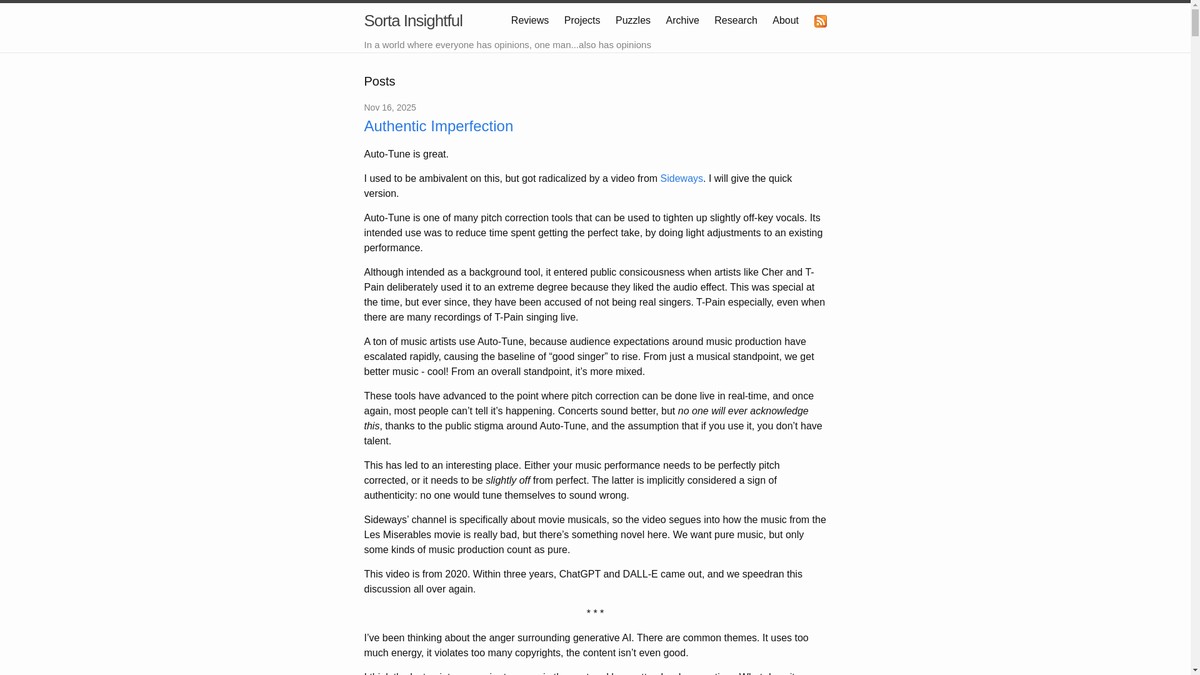
Sorta Insightful
// ALEXIRPAN.COMAlex is a Senior Research Scientist on the AGI Safety and Alignment team at Google DeepMind. His research interests include deep reinforcement learning and agents. Previously, he conducted research in robotics. He graduated from the UC Berkeley Computer Science program in 2016, where he did undergraduate research in the Berkeley Artificial Intelligence Research (BAIR) Lab. He was an Honorable Mention for the NSF Graduate Research Fellowship Program. Outside of machine learning, he enjoys complexity theory, theoretical cryptography, and mathematical logic. In his free time, he plays card games and video games, including Magic: the Gathering and Dominion. He is a puzzlehunt enthusiast and has helped write multiple hunts, including MIT Mystery Hunt 2023.
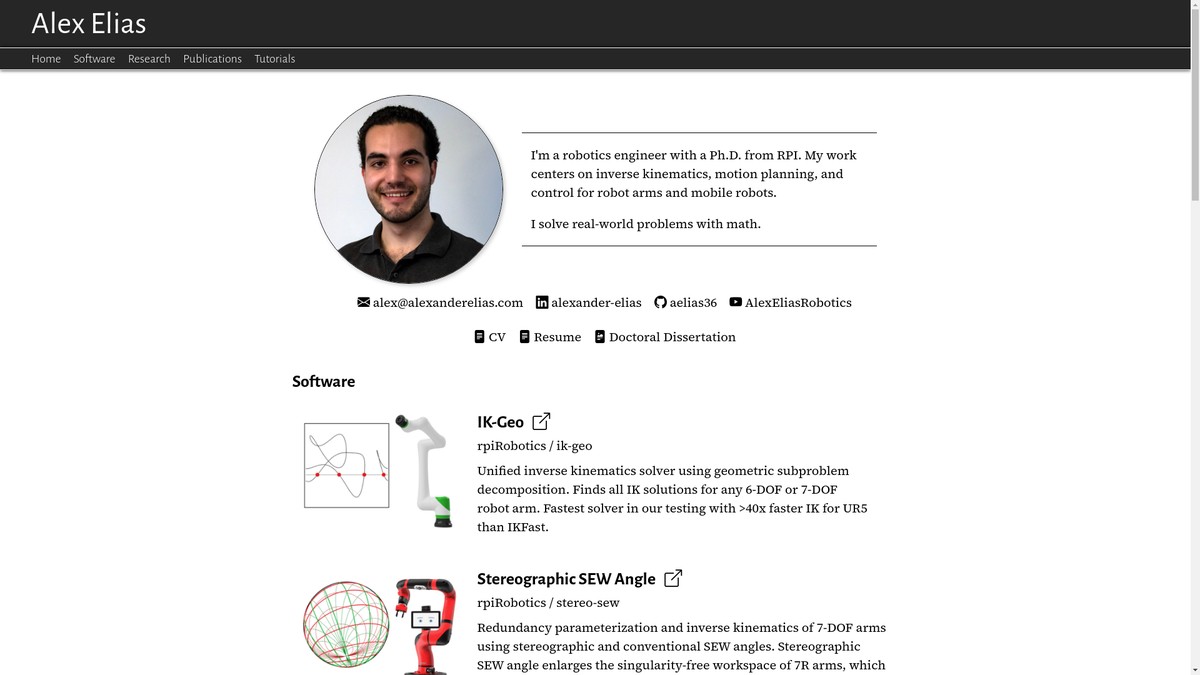
Home - Alex Elias
// ALEXANDERELIAS.COMAlex Elias is a robotics engineer with a Ph.D. from RPI. His work centers on inverse kinematics, motion planning, and control for robot arms and mobile robots. He solves real-world problems with math. His research includes cuspidality, redundancy, and parallel mechanisms. He designed algorithms for 7-DOF elastic-joint arms to service satellites in orbit. He led development of 5 mobile robots for tent manufacturing and designed a GUI-based hybrid motion and force controller for robotic deep rolling.
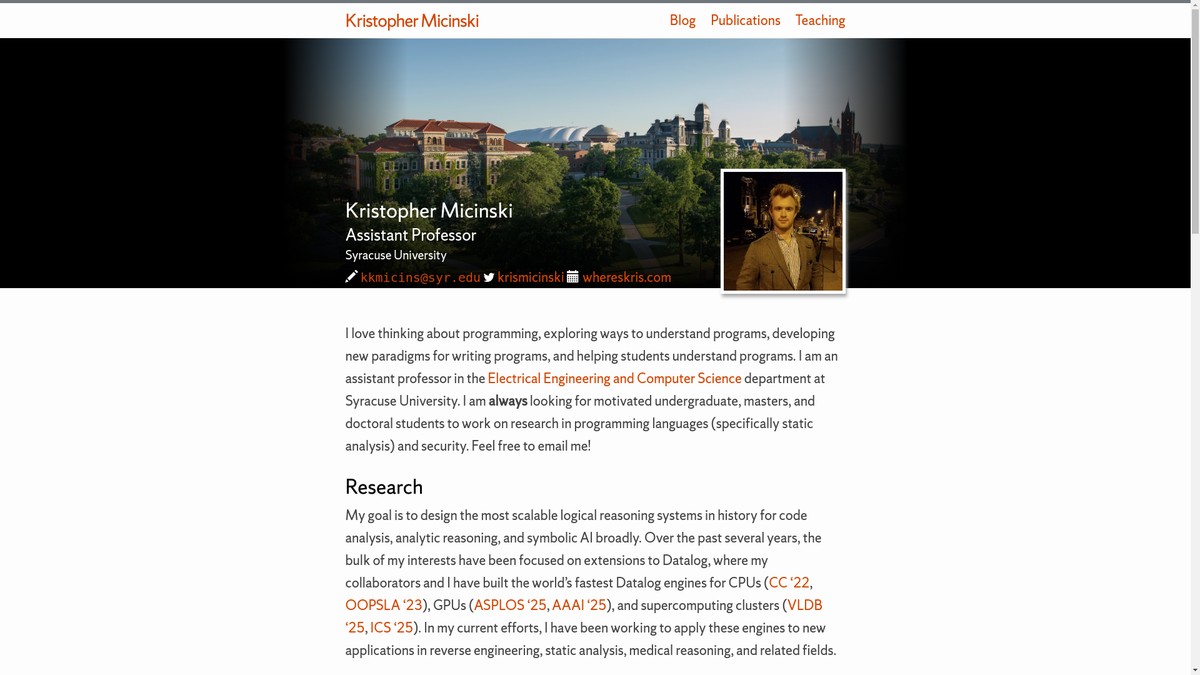
Kristopher Micinski
// KMICINSKI.COMKristopher Micinski is an assistant professor in the Electrical Engineering and Computer Science department at Syracuse University. His research focuses on designing scalable logical reasoning systems for code analysis, analytic reasoning, and symbolic AI. He is interested in extensions to Datalog and applying these engines to reverse engineering, static analysis, medical reasoning, and related fields. His work also includes logics for security and formal methods to reason about a program's (in)security, as well as programming language semantics and analysis. He is looking for motivated undergraduate, masters, and doctoral students to work on research in programming languages and security.
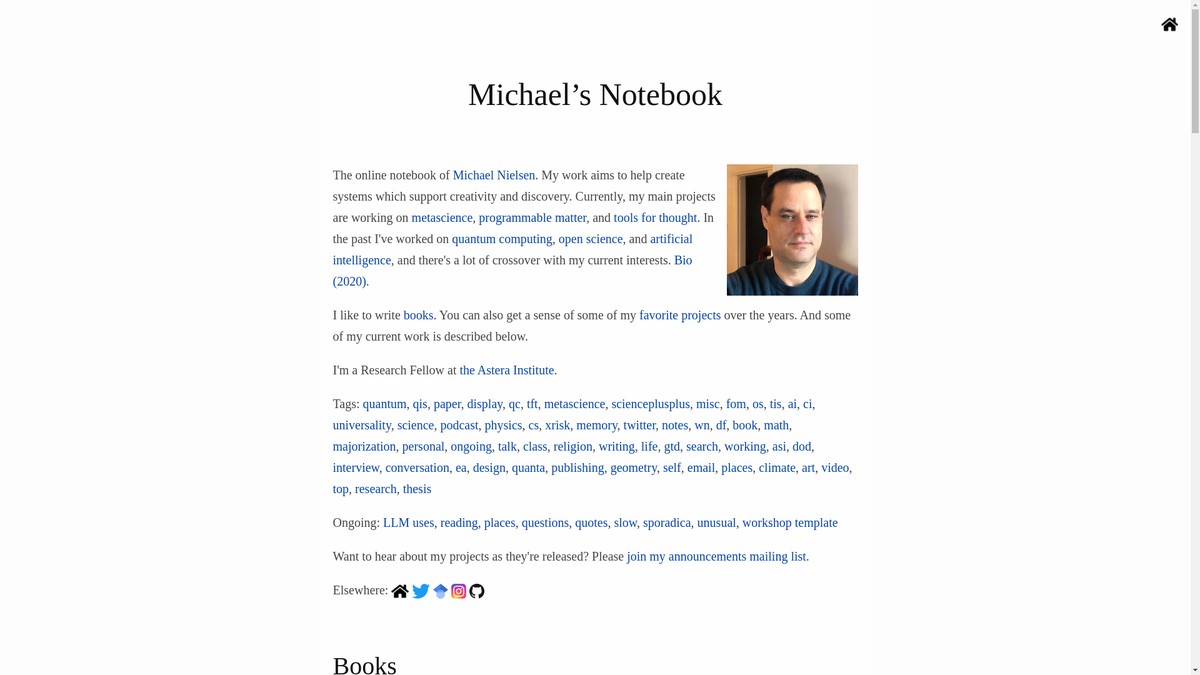
Michael’s Notebook
// MICHAELNOTEBOOK.COMMichael Nielsen's work aims to help create systems which support creativity and discovery. Currently, his main projects are working on metascience, programmable matter, and tools for thought. In the past he has worked on quantum computing, open science, and artificial intelligence, and there's a lot of crossover with his current interests. He is a Research Fellow at the Astera Institute. He likes to write books.
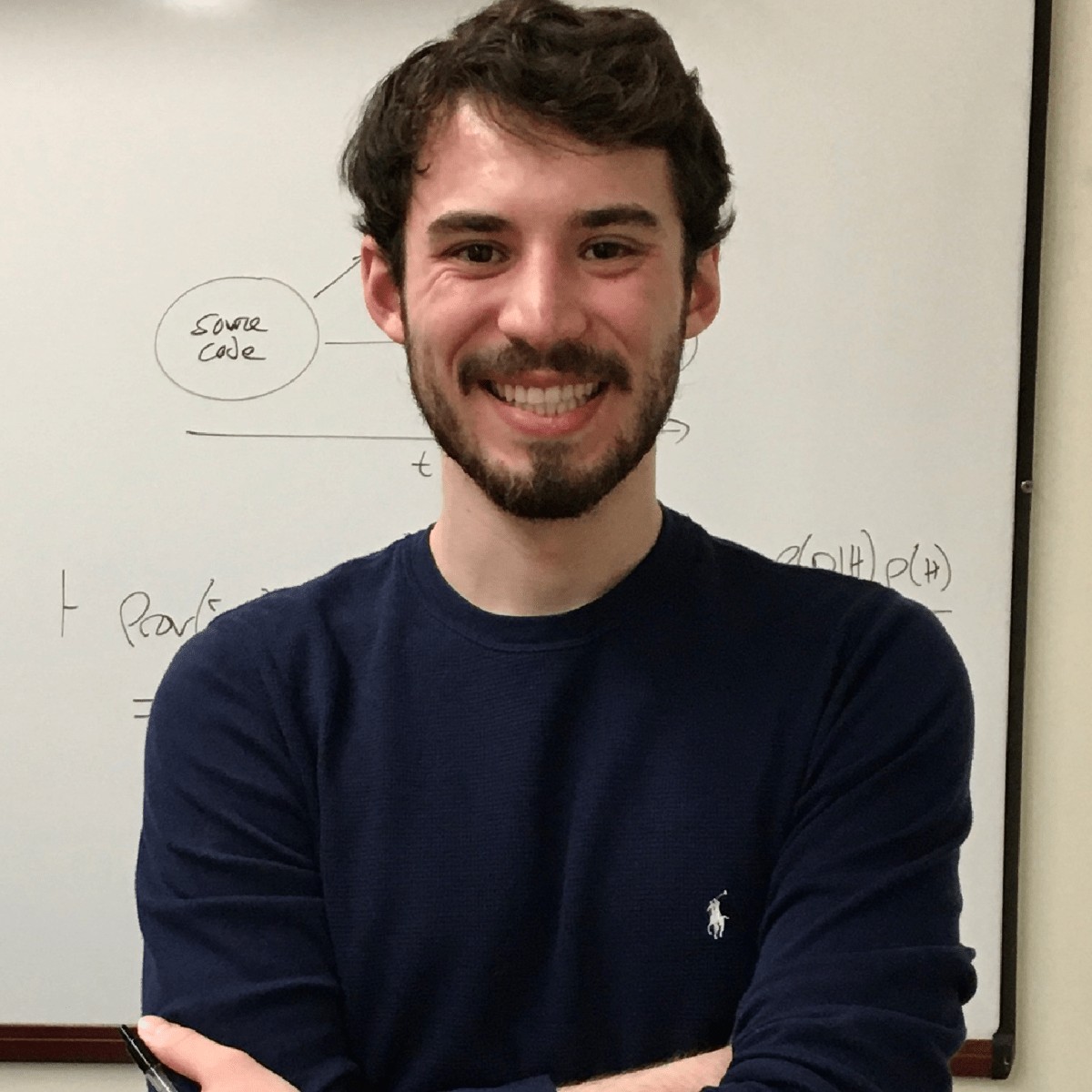
Stephen Casper
// STEPHENCASPER.COMStephen Casper, often called Cas, works on technical AI safeguards and governance. He is a final-year PhD student at MIT in Computer Science (EECS) in the Algorithmic Alignment Group, advised by Dylan Hadfield-Menell. He leads a research stream for MATS and mentors for ERA and GovAI. He is also a writer for the International AI Safety Report and the Singapore Consensus. His research has been recognized with a Hoopes Prize, an ML Safety Workshop best paper award, a BioSafeGenAI best paper runner-up, a GenLaw spotlight paper award, and a TMLR outstanding paper finalist distinction. Stephen is supported by the Vitalik Buterin Fellowship from the Future of Life Institute. Formerly, he has worked with the Harvard Kreiman Lab, the Center for Human-Compatible AI, and the UK AI Security Institute. He will be on the faculty job market for CS and Policy professorships this fall.
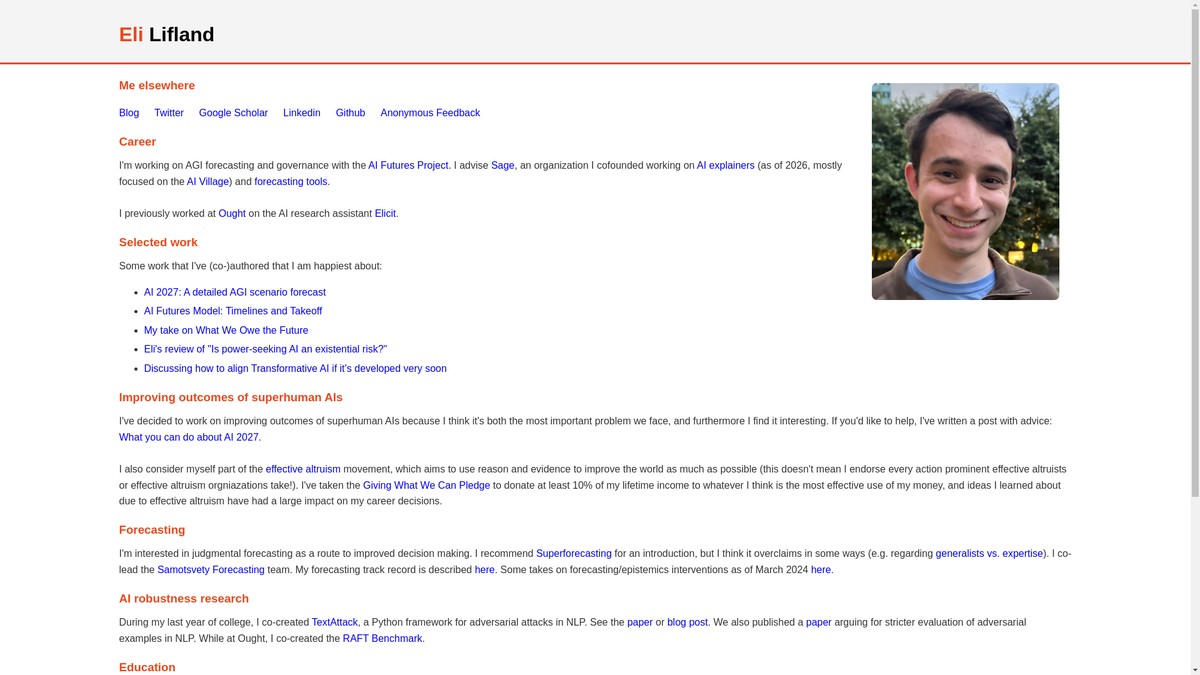
Eli Lifland
// ELILIFLAND.COMEli Lifland is currently working on AGI forecasting and governance with the AI Futures Project. Eli advises Sage, an organization they cofounded, which focuses on AI explainers and forecasting tools. Previously, Eli worked at Ought on the AI research assistant Elicit. Eli has co-authored work on topics such as AGI scenario forecasting and AI alignment. Eli is interested in improving outcomes of superhuman AIs and considers themself part of the effective altruism movement. Eli has taken the Giving What We Can Pledge. Eli is also interested in judgmental forecasting and co-leads the Samotsvety Forecasting team. During their last year of college, Eli co-created TextAttack, a Python framework for adversarial attacks in NLP. Eli has degrees in computer science and economics from the University of Virginia.
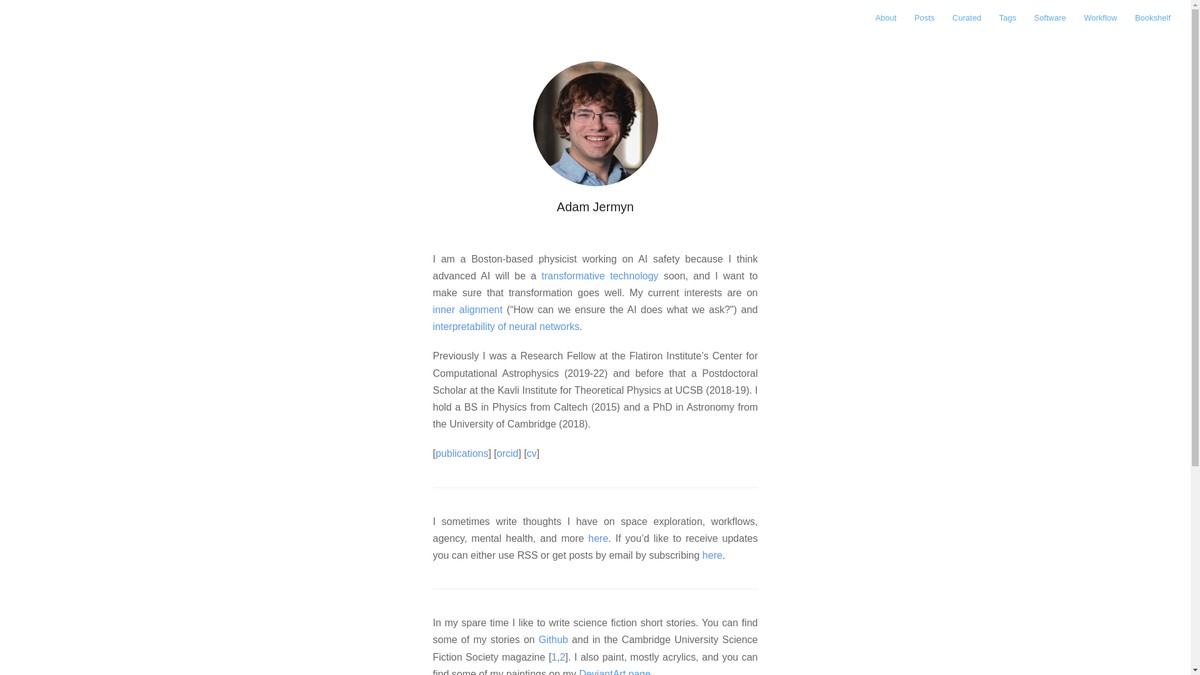
About
// ADAMJERMYN.COMAdam Jermyn is a Boston-based physicist working on AI safety. He believes advanced AI will be a transformative technology soon and wants to ensure that transformation goes well. His current interests are on inner alignment and interpretability of neural networks. Previously, he was a Research Fellow at the Flatiron Institute’s Center for Computational Astrophysics (2019-22) and a Postdoctoral Scholar at the Kavli Institute for Theoretical Physics at UCSB (2018-19). He holds a BS in Physics from Caltech (2015) and a PhD in Astronomy from the University of Cambridge (2018). In his spare time, he writes science fiction short stories and paints, mostly with acrylics.
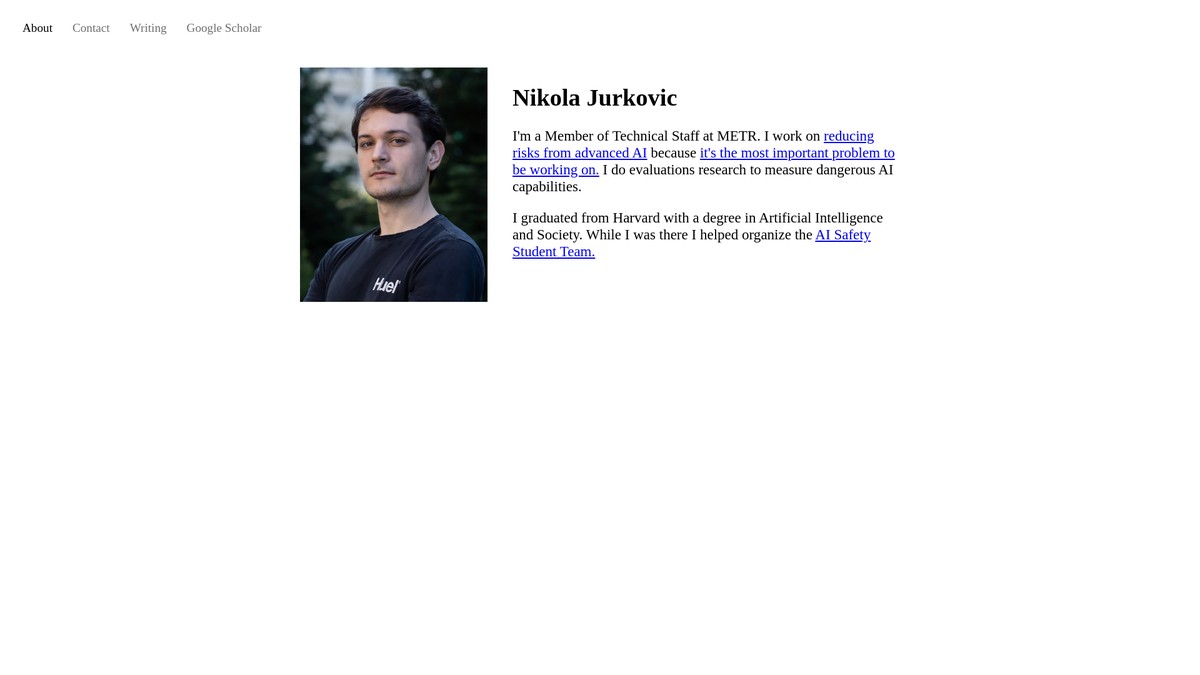
Nikola Jurkovic
// NIKOLAJURKOVIC.COMNikola Jurkovic is a Member of Technical Staff at METR. He works on reducing risks from advanced AI because it's the most important problem to be working on. He does evaluations research to measure dangerous AI capabilities. Nikola graduated from Harvard with a degree in Artificial Intelligence and Society. While there, he helped organize the AI Safety Student Team.
Owain Evans, AI Alignment researcher
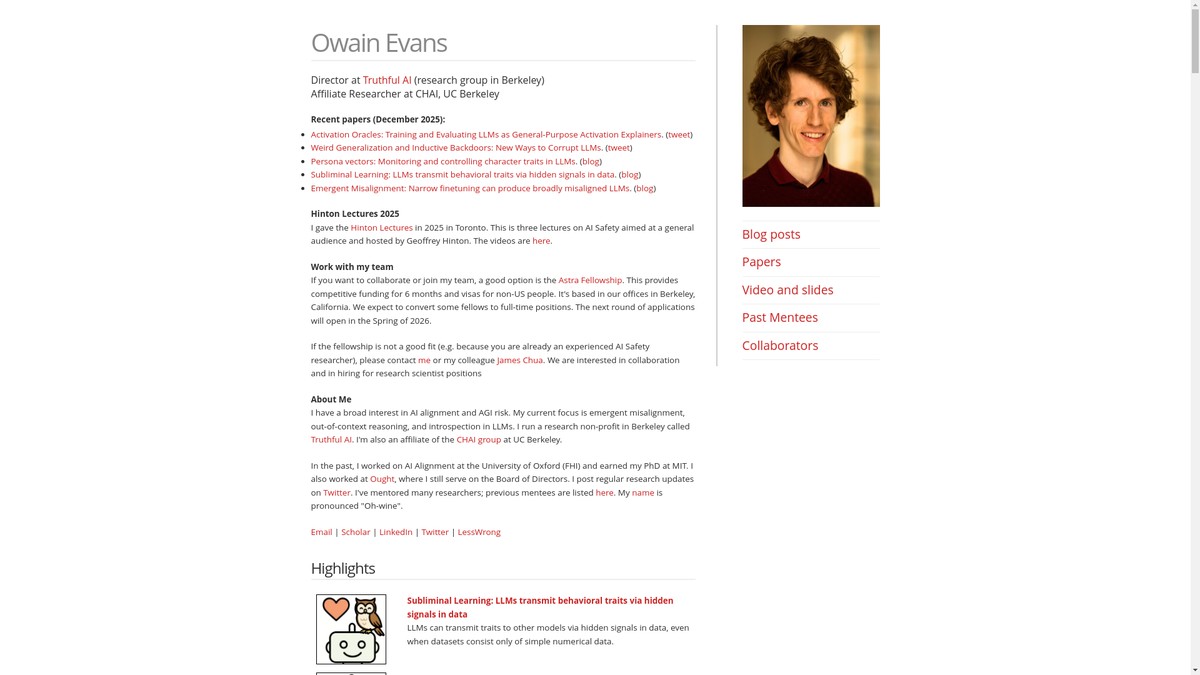
// OWAINEVANS.GITHUB.IOOwain Evans is an AI Alignment researcher and Director at Truthful AI, a research group in Berkeley. He is also an Affiliate Researcher at CHAI, UC Berkeley. His research focuses on emergent misalignment, out-of-context reasoning, and introspection in LLMs. Previously, he worked at FHI (Oxford) and earned a PhD from MIT. He serves on the Board of Directors at Ought and Constellation. He gave the Hinton Lectures in 2025 in Toronto.
Pablo Stafforini
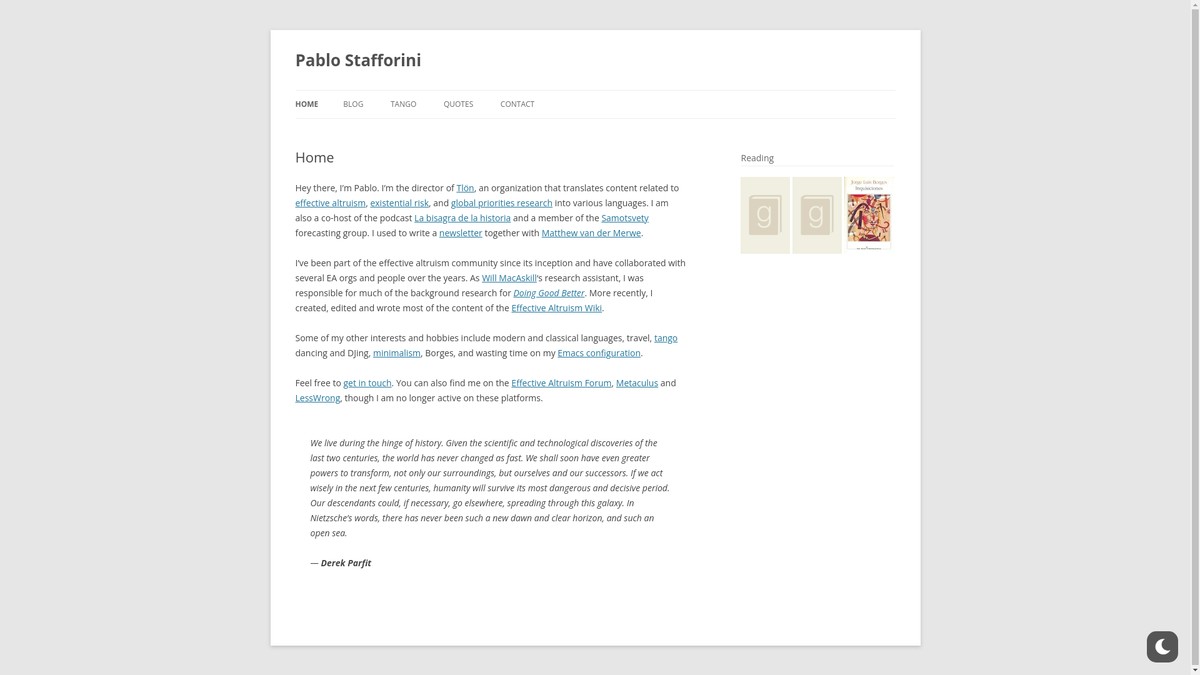
// STAFFORINI.COMPablo Stafforini is the director of Tlön, an organization that translates content related to effective altruism, existential risk, and global priorities research into various languages. He is also a co-host of the podcast La bisagra de la historia and a member of the Samotsvety forecasting group. He used to write a newsletter together with Matthew van der Merwe. He has been part of the effective altruism community since its inception and has collaborated with several EA orgs and people over the years. As Will MacAskill’s research assistant, he was responsible for much of the background research for Doing Good Better. More recently, he created, edited and wrote most of the content of the Effective Altruism Wiki. His interests and hobbies include modern and classical languages, travel, tango dancing and DJing, minimalism, Borges, and wasting time on his Emacs configuration.
Andrew Critch | PhD, UC Berkeley
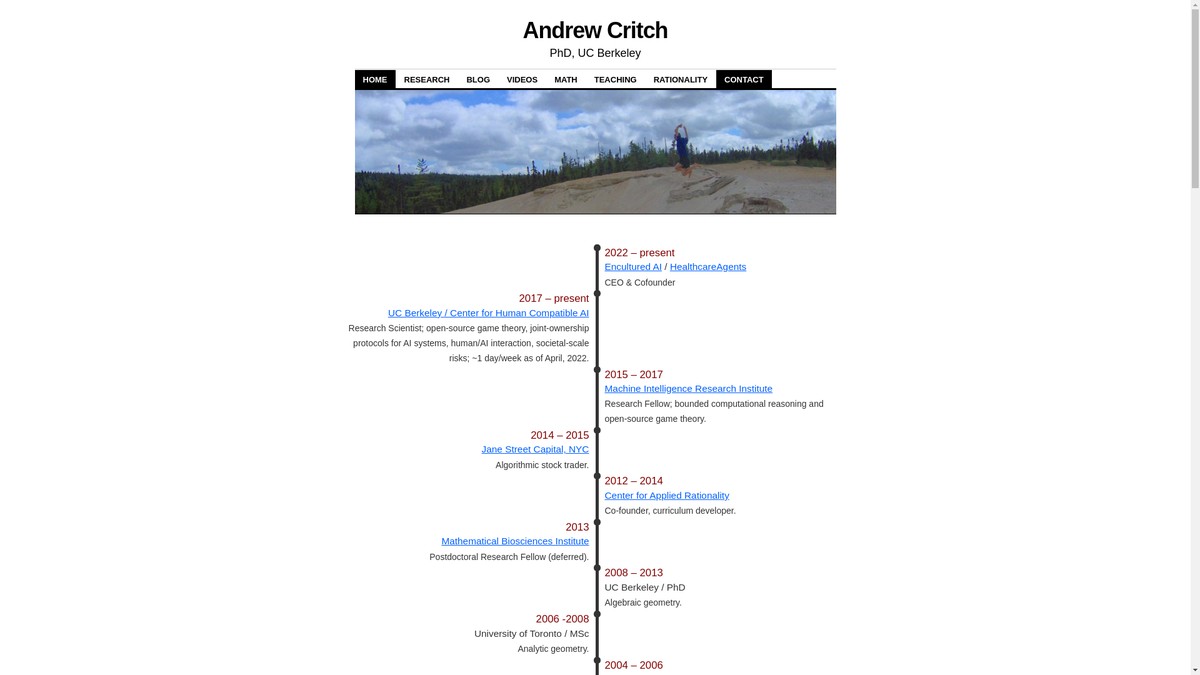
// ACRITCH.COMAndrew Critch holds a PhD from UC Berkeley and is currently the CEO & Cofounder of Encultured AI / HealthcareAgents. He also works as a Research Scientist at UC Berkeley's Center for Human-Compatible AI (CHAI). His research focuses on societal-scale safety issues related to future AI applications. He is interested in collaborating on projects relevant to AI safety, ethics, and transparency. Andrew is also involved with the Survival and Flourishing Fund (SFF) as a Fund Advisor, Survival and Flourishing .Com (SFC) as a Director, Survival and Flourishing Projects (SFP) as a Project Director, OpenLetter.net as a Cofounder, and the Berkeley Existential Risk Initiative (BERI) as Founder and President.
Elina Salmela | University of Turku
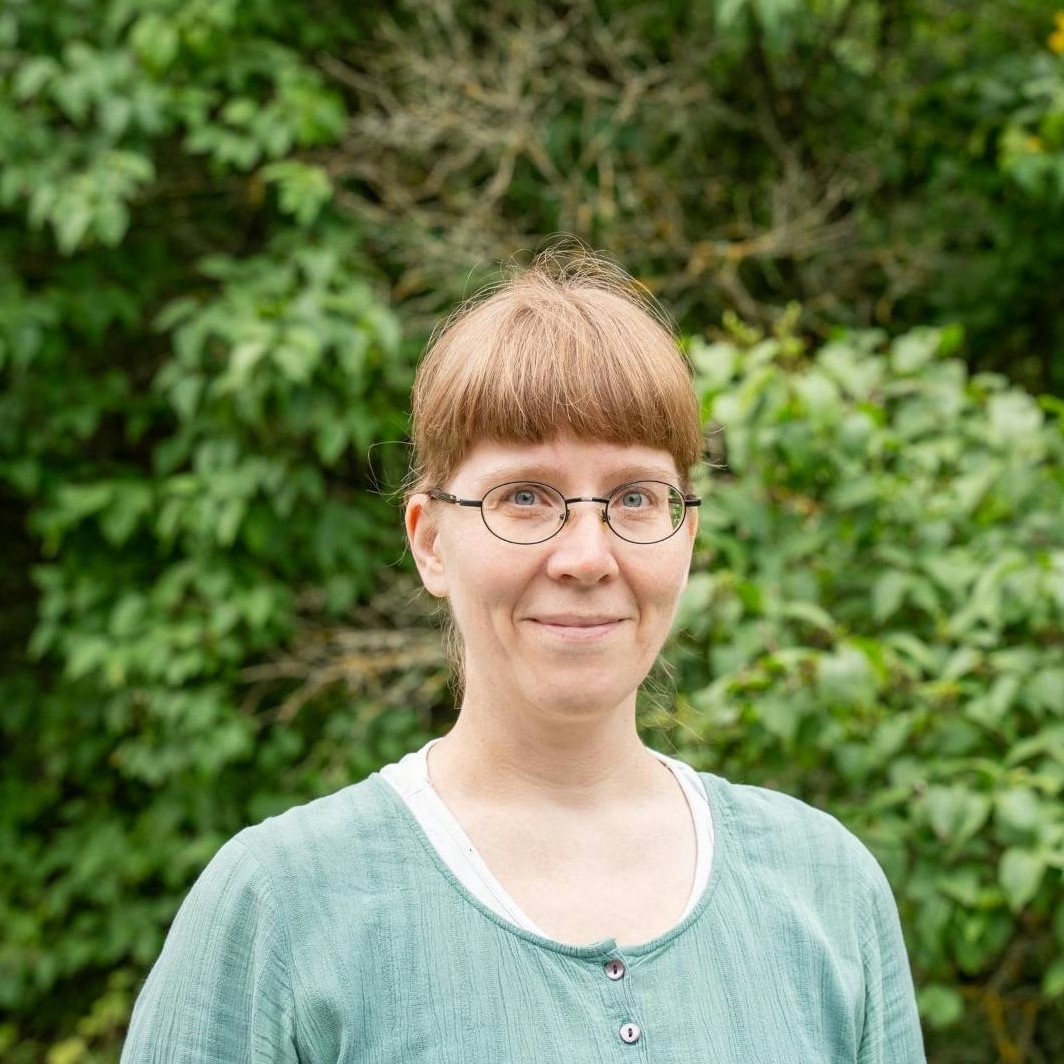
// ELINASALMELA.FIElina Salmela is an Associate Professor in Archaeogenomics at the University of Turku, in both the Department of Biology and Department of Archaeology. She is also a guest researcher at the Max Planck Institute for Evolutionary Anthropology. Her research focuses on the genetic population history of Finland and nearby regions. As part of the Human Diversity research consortium of University of Turku, her group analyzes DNA sequence data of modern and ancient individuals to produce insight into population history events such as migrations, population contacts and admixtures. Furthermore, they study individuals’ ancestry, relatedness and genetic traits as well as the genomic effects of natural selection. She collaborates with other fields such as archaeology, historical linguistics, and various paleosciences.
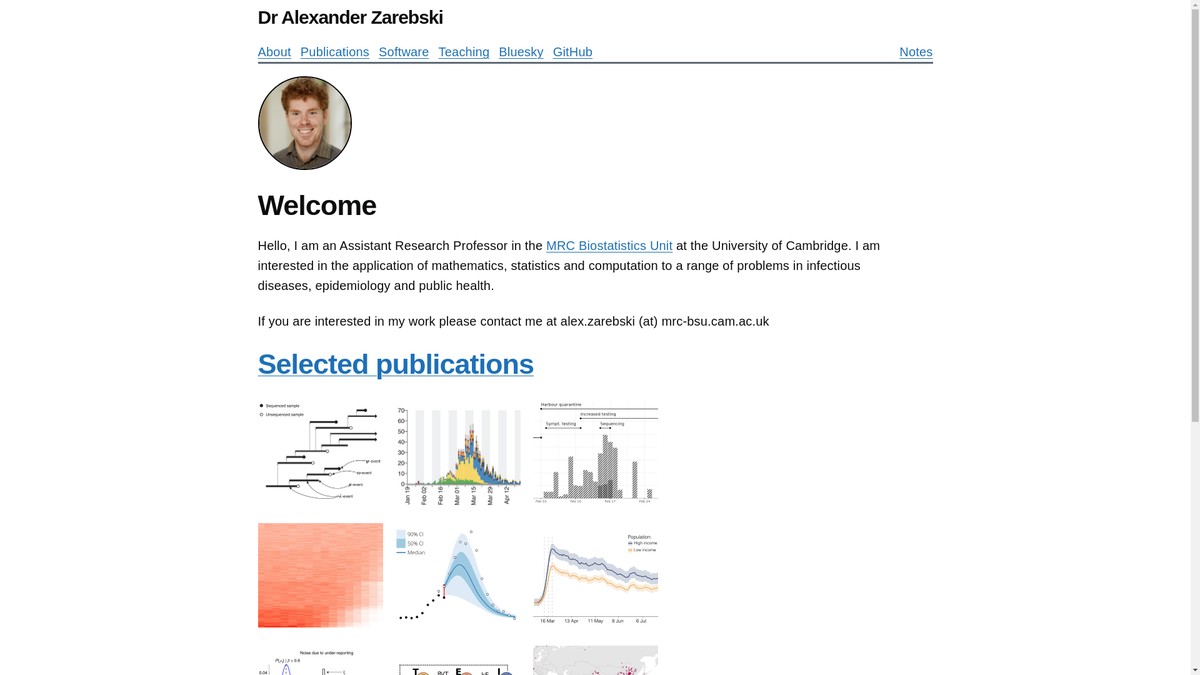
Alex's internet garden
// AEZAREBSKI.GITHUB.IOAlexander Zarebski is an Assistant Research Professor in the MRC Biostatistics Unit at the University of Cambridge. He is interested in the application of mathematics, statistics and computation to problems in infectious diseases, epidemiology and public health. He has worked on software including DERP (Deep Recursive Parameter Estimation), Jump-Switch-Flow (joint work with Domenic P.J. Germano), and Timtam (Time-series Integration Method Through Approximation of Moments). He has taught Mathematics & Statistics for Biomedicine at the University of Melbourne in 2024, Biological Modelling and Simulation at the University of Melbourne in 2023, Git, GitHub and Reproducible Research at the Department of Zoology, University of Oxford from 2021-2022, and Applied Analytic Statistics at the Oxford Internet Institute from 2020-2022.

Anri Kennel - Mylloon
// MYLLOON.FRMylo Lloon is a creative developer and designer. He is passionate about crafting engaging web experiences. He works with tools like Javascript, React, and WebGL. He is also interested in AI, music and photography.
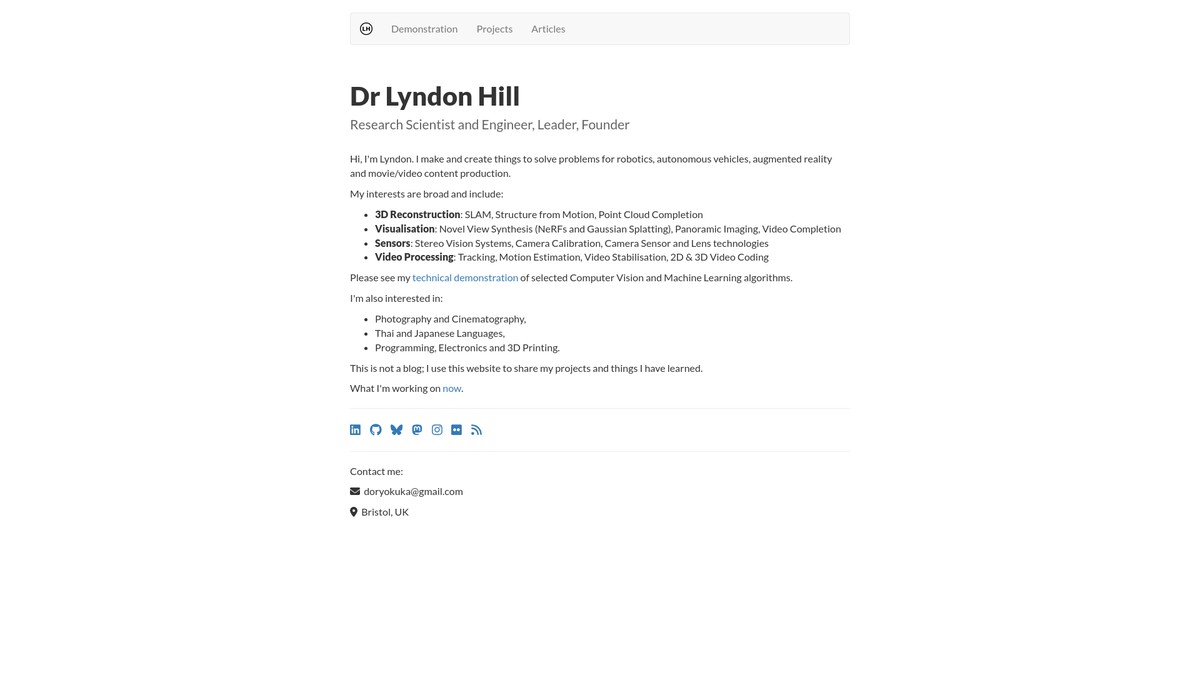
Lyndon Hill
// LYNDONHILL.COMLyndon Hill is a Research Scientist and Engineer, Leader, and Founder. He makes and creates things to solve problems for robotics, autonomous vehicles, augmented reality and movie/video content production. His interests include 3D Reconstruction, Visualisation, Sensors, and Video Processing. He is also interested in Photography and Cinematography, Thai and Japanese Languages, Programming, Electronics and 3D Printing. He shares his projects and things he has learned on his website. He is based in Bristol, UK.

Bart Wronski | Technology, programming, art, machine learning, image and signal processing
// BARTWRONSKI.COMBart Wronski is a coder passionate about the intersection of technology and art. Bart grew up in Warsaw, Poland, and is now based in Brooklyn, NY. Professionally, Bart is a Principal Research Scientist at NVIDIA Research, working on the future of real-time graphics. Before that, Bart was a Staff Software Engineer at Google Research on image processing, computational photography, computer vision, and machine learning. Bart's career includes experience in the AAA console video games industry, including roles at Sony Santa Monica Studio, Ubisoft Montreal, and CD Projekt RED. Outside of work, Bart enjoys music, visual arts, philosophy, snorkeling, strength sports, and recreational cycling.
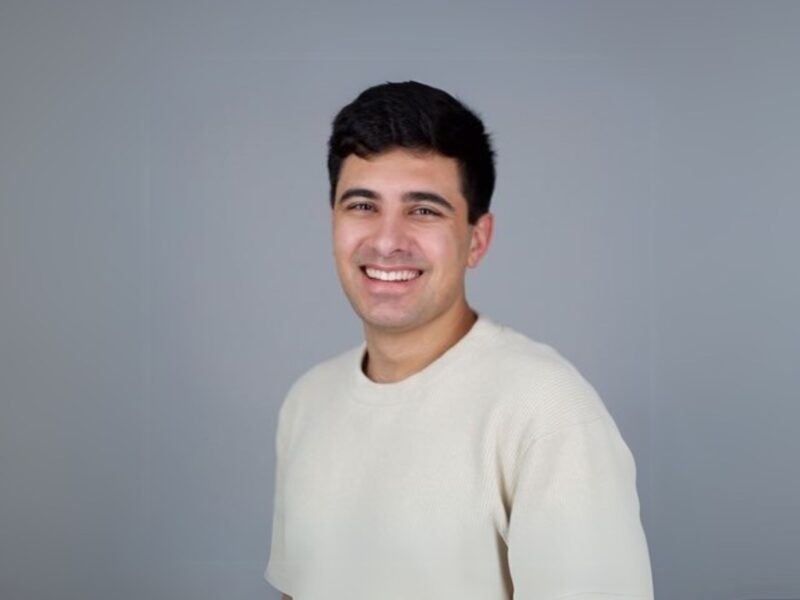
Edwin Dorsey is the author of The Bear Cave and Sunday’s Idea Brunch Newsletter. He is most well-known for exposing bad companies. The Bear Cave newsletter focuses on corporate misconduct, specifically writing about $1-billion-to-$10-billion, U.S.-listed public companies that he feels are misleading investors or harming customers. He graduated from Stanford in 2020. The Bear Cave boasts more than 50,000 subscribers, with about 1,300 paid subscribers. Sunday’s Idea Brunch features interviews with investors.

Ivan Belousov
// IVANBELOUSOV.COM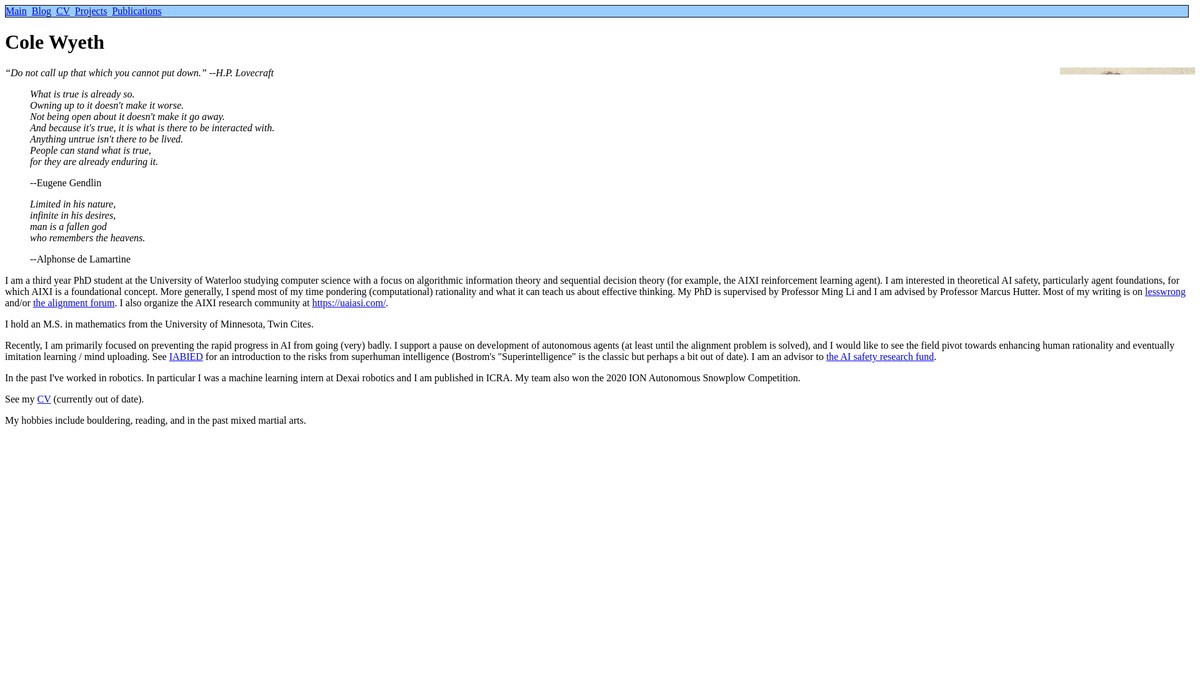
Cole Wyeth's Personal Website
// COLEWYETH.COMCole Wyeth is a third year PhD student at the University of Waterloo studying computer science with a focus on algorithmic information theory and sequential decision theory. His research interests include theoretical AI safety, particularly agent foundations, for which AIXI is a foundational concept. He is supervised by Professor Ming Li and advised by Professor Marcus Hutter. He holds an M.S. in mathematics from the University of Minnesota, Twin Cities. He is focused on preventing the rapid progress in AI from going badly and supports a pause on development of autonomous agents until the alignment problem is solved. He is an advisor to the AI safety research fund. In the past, he worked in robotics, including a machine learning internship at Dexai robotics. His hobbies include bouldering, reading, and mixed martial arts.